Strich SDP-350W vs AODSK UPB-83S
Quick Verdict
The Strich SDP-350W has stronger published specs for home use: 20 watt speakers, 128 note polyphony, 128 timbres, 200 rhythms and a complete furniture bundle with three pedals, headphones and a dust cover. The AODSK UPB-83S is a heavier, more traditional console style option with three pedals and dual headphone jacks but no published speaker wattage or Bluetooth. Choose the Strich if you want better listed sound output and more rhythms. Choose the AODSK if you prefer a heavier cabinet and dual headphone practice. Both are unproven on key action quality, so try before you buy.

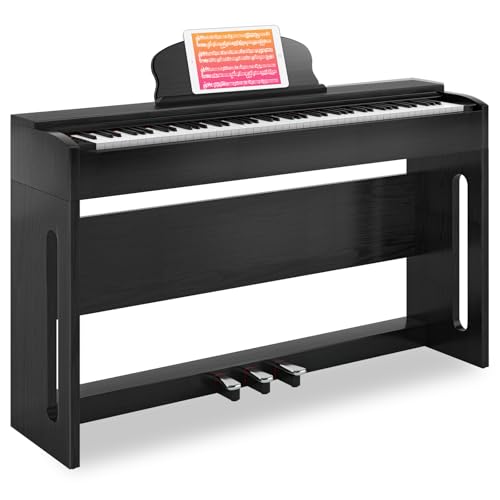
| Spec | Strich SDP-350W | AODSK UPB-83S |
|---|---|---|
| Keys | 88 | 88 full-sized weighted keys |
| Key action | Hammer-action fully weighted with simulated ivory texture | Fully weighted professional piano keys |
| Polyphony | 128 max | 128 |
| Sounds | 128 preset timbres, 200 drum rhythms | 128 timbres and 88 demonstration songs |
| Speakers | 20W | Built-in amplifier with speakers, wattage not published |
| Connectivity | Audio in, USB MIDI, wireless connection mentioned | MP3 input, external speaker or headphone output, dual headphone jack |
| Bluetooth | Not published in listing | Not published in listing |
| Pedals included | Three pedals | Three pedals: soft, sustain, sostenuto |
| Weight | Not published in listing | 71.2 lbs |
| Included accessories | Furniture stand, headphones, three pedals, flip top key cover, power adapter | Stand, pedals, music stand, beginner course access |
Key Action
The Strich SDP-350W lists 88 hammer action fully weighted keys with a simulated ivory texture. The AODSK UPB-83S lists 88 full sized fully weighted professional piano keys. Both listings describe weighted actions, but neither names a key action manufacturer or a specific mechanism. The Strich specifies simulated ivory, which may affect finger grip and moisture control, while the AODSK only uses the term professional without detail.
In the supplied scoring, the Strich receives 21 out of 30 for key action and the AODSK receives 18 out of 30. That difference suggests the Strich listing gives slightly more detail about touch materials, but not enough to confirm real world feel. The AODSK has full sized keys and a 71.2 lb cabinet, which may feel stable, but weight is not an action quality factor. Without published velocity response or escapement behavior, both actions remain unverified from the listing.
Buyers who prioritize a specific graded or triple sensor action will not find that information here. If you cannot try these pianos, treat the listed key action as a basic weighted hammer action. The Strich simulated ivory texture is a concrete feature, while the AODSK professional keys are a marketing phrase. For beginners, both should provide a weighted practice surface, but advanced players may notice limitations that the listings do not disclose.
Piano Sound and Speakers
The Strich lists 20 watt speakers, 128 note max polyphony, 128 preset timbres and 200 drum rhythms. The AODSK lists 128 note polyphony, 128 timbres and 88 demonstration songs, with a built-in amplifier and speakers but wattage not published. The Strich 20 watt speaker output is a concrete advantage for room filling volume, while the AODSK speaker power is unknown. Both have 128 note polyphony, which is sufficient for many piano pieces without note stealing.
The piano sound source and sample quality are not published for either model. The Strich does not identify its piano sample or sound engine. The AODSK also leaves the sound engine unspecified. The number of timbres, 128 on both, suggests a wide range of instrument and synth sounds, but not the authenticity of the acoustic piano tone. The Strich adds 200 drum rhythms, which may be useful for practice accompaniment and casual play.
The AODSK includes 88 demonstration songs, which can help students hear examples, while the Strich does not list a demo song count but includes rhythms. The score difference, 17 out of 25 for the Strich and 12 out of 25 for the AODSK, reflects the Strich published wattage and broader rhythm content. However, without hearing either, the actual piano tone quality cannot be ranked from these specs. Buyers who want a louder built-in system should note the Strich 20 watt rating and the AODSK missing wattage.
Features and Modes
The Strich features include 128 preset timbres, 200 drum rhythms, wireless connection, USB MIDI, audio in, and three pedals. The listing mentions wireless but does not specify Bluetooth. The AODSK features include 128 timbres, 88 demonstration songs, recording, playback, split and teaching functions, dual headphone jacks, MP3 input, and three pedals. Both include learning oriented modes, but the AODSK explicitly lists split and teaching functions while the Strich does not mention split in the supplied facts.
The AODSK has recording and playback, which is useful for self assessment. The Strich does not list recording or playback in its supplied features, so that may be absent or simply not mentioned. The Strich has wireless and USB MIDI options for teaching apps, while the AODSK connectivity lacks wireless but has MP3 input and external speaker or headphone output. The Strich 200 rhythms are a substantial add for backing tracks, while the AODSK 88 demo songs may be more limited.
Both have 128 note polyphony, three pedals, and a music stand. The Strich includes headphones in the box, while the AODSK has dual headphone jacks for two players. In features scoring, the Strich receives 11 out of 15 and the AODSK receives 9 out of 15. That gap likely comes from the Strich wireless mention and larger rhythm library. Buyers who want recording should check if the AODSK fits, and if wireless app use matters, the Strich has the clearer path, though protocol is unstated.
Build, Design and Portability
The Strich SDP-350W includes a furniture stand, flip top key cover, three pedals, and a dust cover. However, its total weight and dimensions are not published in the listing. The AODSK UPB-83S includes a wooden stand and weighs 71.2 lbs, which is a specific heavy console weight. The Strich missing weight makes direct portability comparison difficult, but its bundled furniture stand suggests a similar home furniture design rather than a portable slab.
The AODSK 71.2 lb weight confirms it is stationary and not meant for frequent transport. The Strich build appears from the included flip top key cover and furniture stand to be a cabinet style piano, but without weight or dimensions the listing cannot confirm if it is lighter or heavier. The AODSK three pedals are soft, sustain and sostenuto, while the Strich only says three pedals without naming functions, though likely similar.
In build and portability scoring, both receive 7 out of 10. That equal score seems odd because one has a known heavy weight and the other is unknown, but the scoring may consider included furniture accessories. Buyers who need to move the piano regularly should ask the seller for the Strich weight and dimensions. The AODSK is clearly heavy, so apartment dwellers with stairs should plan accordingly. Neither is a portable stage piano.
Connectivity
The Strich lists audio in, USB MIDI, and a wireless connection mentioned. Bluetooth is not published in the listing, so the wireless protocol could be a proprietary or unnamed radio. The AODSK lists MP3 input, external speaker or headphone output, and a dual headphone jack. The AODSK does not list Bluetooth or USB MIDI in the supplied specs. This is a significant difference: the Strich has USB MIDI for computer and app connection, while the AODSK appears limited to analog audio only.
The Strich audio input means you can play along with external music through its 20 watt speakers. The AODSK has MP3 input as well, plus external speaker output, which can be useful for connecting to a PA or recording interface. The dual headphone jack on the AODSK is a clear advantage for teacher and student or two players practicing quietly. The Strich has only one headphone output listed, though it includes a pair of headphones.
For digital connectivity, the Strich is more versatile because USB MIDI allows direct connection to music software and teaching apps, while the wireless feature may do the same if the protocol is supported. The AODSK lack of USB MIDI and Bluetooth means it may be limited to its internal sounds and analog inputs. In connectivity scoring, the Strich receives 6 out of 10 and the AODSK receives 5 out of 10. That one point difference reflects the Strich USB MIDI and wireless mention but also the ambiguity of its wireless protocol.
Setup and Accessories
Both models come as furniture style packages that require some assembly. The Strich includes a furniture stand, three pedals, headphones, flip top key cover, and power adapter. The AODSK includes a stand, three pedals, music stand, and beginner course access. The Strich included headphones and flip top key cover are notable extras that protect the keys and allow immediate practice. The AODSK beginner course access adds instructional value but may require a subscription or online registration.
Neither listing specifies assembly time or instructions quality. The AODSK known weight of 71.2 lbs means two person assembly is advisable. The Strich weight is not published, so it may be similar or lighter, but the furniture stand indicates a console style assembly. Both have power adapters included, but the Strich explicitly lists a power adapter while the AODSK does not mention power adapter among accessories though it likely requires one.
If you want a complete out of the box home setup, the Strich bundle is stronger because it adds headphones and a dust cover. The AODSK bundle is also complete for basic playing with pedals, stand and a music stand. The beginner course access on the AODSK could be helpful for a new player who wants guided lessons, but the specifics of the course length and format are not published. Buyers should verify whether the course is physical media, online, or a short trial.
Daily Use
For daily practice, both pianos offer 88 fully weighted keys, which is the key requirement for building finger strength and transitioning to an acoustic piano. The Strich 20 watt speakers are likely adequate for a small to medium living room, while the AODSK speaker wattage is unknown so volume may be a gamble. The Strich wireless and USB MIDI connections make it easier to integrate with teaching apps, assuming the wireless protocol is supported. The AODSK dual headphone jacks are useful for silent practice with a teacher or parent.
The AODSK recording and playback functions allow a student to listen to their performance without extra equipment. The Strich does not list recording or playback, which may be a drawback for self evaluation. The Strich 200 drum rhythms can make practice more engaging, especially for pop and rock repertoire, while the AODSK 88 demo songs provide classical and standard pieces to reference. The three pedals on both support proper pedal technique from the start.
The heavy AODSK cabinet is stable and may not shift during aggressive playing, but it is difficult to move for cleaning or rearrangement. The Strich flip top key cover helps keep dust off the action, which is a daily use benefit if the piano sits in a living area. Both include a music stand for sheet music or a tablet. Neither has a published app compatibility list, so check that your preferred software works before purchase.
The Deciding Question
The deciding question is whether you value a known speaker output and more modern digital connectivity, or a heavier traditional cabinet with dual headphone outputs and recording features. The Strich SDP-350W publishes 20 watt speakers, USB MIDI and a wireless connection, plus 200 rhythms and a complete bundle with headphones and a dust cover. The AODSK UPB-83S publishes a specific 71.2 lb weight, dual headphone jacks, recording and playback, and an included beginner course, but leaves speaker wattage and Bluetooth unspecified.
If you need to connect to a computer or iPad for apps and soft synths, the Strich is the clearer choice because it has USB MIDI. If you expect to play along with external audio from a phone or tablet, both have analog inputs, but the Strich has a rated amplifier while the AODSK does not. If two people will practice silently with headphones, the AODSK dual headphone jack is a simple hardware advantage that the Strich listing does not match.
The overall scores, 70 for the Strich and 58 for the AODSK, reflect the Strich more complete published specifications in several categories. However, both have significant unknowns about key action quality and piano sample source. The deciding question is not which is universally better, but which unverified trade offs you accept. If speaker wattage and USB MIDI matter most, choose the Strich. If recording, dual headphone practice and beginner course access matter most, choose the AODSK.
Who Should Buy Which
Buyers who want a complete home piano package with a dust cover, headphones, three pedals, a stand, and a known 20 watt speaker system should look at the Strich SDP-350W. Its larger rhythm library and USB MIDI make it a better fit for casual players who want to explore different sounds and connect to apps. The Strich is also better if Bluetooth or wireless app use is a priority, though the wireless protocol is not confirmed in the listing.
The AODSK UPB-83S is for buyers who want a heavy, stable furniture style piano with dual headphone jacks, recording and playback, and an included beginner course. It is well suited to a quiet household where two students need to practice with headphones, or where the player wants to record and review their sessions. Its 71.2 lb weight is a commitment, so it fits a permanent spot in a living room or studio.
Neither model is ideal for gigging musicians or those who need a lightweight portable slab. Neither has a proven key action from an established brand, so advanced players may be disappointed. Beginners who cannot try before buying should treat both as entry level furniture pianos with solid feature counts but unverified touch and tone. Choose the Strich for its published speaker wattage and digital connectivity. Choose the AODSK for its recording, dual silent practice and course bundle.
Strich SDP-350W
Pros
- 88 fully weighted hammer action keys as listed
- 128 note max polyphony plus 128 timbres and 200 rhythms
- Includes furniture stand, three pedals, headphones and dust cover
- 20 watt speakers with audio input for external devices
- Wireless and USB MIDI options for teaching apps
Cons
- Key action brand and piano sample source not published
- Weight and dimensions are missing from the listing
- Wireless protocol is not named as Bluetooth
- Speaker driver configuration is unclear
- No warranty or app compatibility list provided
AODSK UPB-83S
Pros
- Full 88 key weighted action included at a budget tier
- 128 note polyphony and 128 timbres
- Three pedals and a wooden stand are part of the package
- Dual headphone outputs for two players
- Beginner course included
- Recording, playback, split and teaching functions
Cons
- At 71.2 lbs the unit is not very portable
- Speaker wattage and amplifier details are not published
- No Bluetooth listed
- Key action quality and long term durability are unproven in the listing
- Sound engine source is unspecified
Who Should Buy Each
Strich SDP-350W
- A first time piano buyer who wants an all in one package
- Someone with a living room or bedroom where a furniture style piano fits
- A casual player who enjoys rhythms, auto chord and many sounds
- A student who will use a teaching app through USB or wireless connection
AODSK UPB-83S
- Beginners who want a full 88 key weighted action at home
- Students who need a stand and three pedals without separate purchases
- Households that want dual headphone practice for two people
- Buyers who prefer a wooden furniture style cabinet
Quick Decision Guide
| If you want a complete home bundle with a known 20 watt speaker system and a dust cover | Choose Strich SDP-350W |
| If you need dual headphone jacks for two players to practice quietly | Choose AODSK UPB-83S |
| If you plan to connect to a computer or tablet via USB MIDI for apps or soft synths | Choose Strich SDP-350W |
| If you want recording and playback functions to review your practice sessions | Choose AODSK UPB-83S |
| If you want more rhythm variety and wireless app connectivity options | Choose Strich SDP-350W |
FAQ
About This Comparison
Mandrillis Team
The Mandrillis editorial team researches and compares audio and music gear using manufacturer documentation, verified specs and real buyer feedback, so you can make a confident purchase without wading through marketing claims.
Read our full research methodology.
We may earn a commission at no extra cost to you.