Digital Pianos Review
Wencai C01 Review: Hammer Action Home Piano
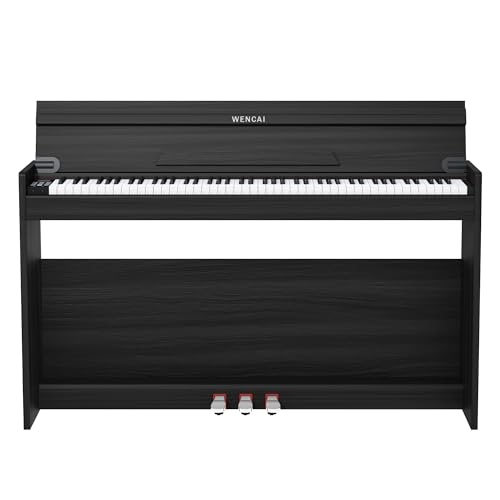
The Wencai C01 is a lower mid-range home digital piano with 88 fully weighted hammer action keys, a soft-close fallboard, 380 tones, 128 rhythms and a three-pedal unit. The listing leaves some specifications unpublished, especially polyphony and weight, but it looks like a practical first piano.
Our Verdict
Research Score 70/100The Wencai C01 is a sensible choice for a beginner or casual home player who wants a furniture style digital piano with a hammer action, a soft-close fallboard and a traditional three-pedal setup. The published feature set is generous for the lower mid-range price, with 380 tones, 128 rhythms and an included USB-MIDI connection. The main limits are informational. The listing does not state polyphony, weight or assembled dimensions, and there is no Bluetooth or line output. That makes it harder to judge how it will perform with dense classical pieces or fit in a specific room. On paper, it is best treated as a fixed home instrument rather than a portable stage piano.
Editorial research score based on published specifications and documented features, not a customer rating or lab test.
Wencai
Wencai C01
Best for: Beginners and home players who want a fixed 88 key hammer action piano with a traditional pedal setup and soft-close fallboard.
Skip it if: You need a lightweight stage instrument with known polyphony, Bluetooth or flexible audio outputs.
Check Price on AmazonWe may earn a commission at no extra cost to you.
Listing verified: October 2026
Who Should Buy It
Buy it if
- A first-time learner who wants a dedicated home piano with a realistic key feel.
- A player who values a soft-close fallboard and traditional three-pedal layout.
- A hobbyist interested in many tones and rhythms for practice or arranging.
- A buyer who can accommodate a full size home console and does not need wireless features.
Skip it if
- You need to know polyphony and dynamic voice allocation before buying.
- You want Bluetooth audio, MIDI over wireless, or line outputs.
- You prefer a lightweight slab style digital piano for gigs or small spaces.
Key Specifications
| Keys | 88 fully weighted hammer action keys |
| Key action | Fully weighted hammer action with 16 levels of touch sensitivity |
| Polyphony | Not published in listing |
| Sounds | 380 tones, 128 rhythms, 88 demos |
| Speakers | Two 4 ohm 15 watt speakers |
| Connectivity | USB-MIDI cable included |
| Bluetooth | Not published in listing |
| Pedals included | Metal three-pedal unit |
| Weight | Not published in listing |
| Included accessories | Power supply, manual, pedal, USB-MIDI cable |
Overview
The Wencai C01 is a lower mid-range home digital piano built around an 88 key fully weighted hammer action. The product listing positions it as an upright electric piano for beginners and professionals who want a traditional console design at home. The main physical features are a soft-close fallboard, a metal three-pedal unit and a full size keybed.
On paper, the C01 offers a broad feature set for the price. The listing states 380 tones, 128 rhythms, 88 demo songs and a pair of 15 watt speakers. It also includes a USB-MIDI cable. Some important specifications are absent, including polyphony, weight and assembled dimensions, so this review treats those as unknowns rather than assumptions.
For a buyer who wants a stationary home piano rather than a portable keyboard, the C01 looks appealing. The combination of a weighted hammer action, three pedals and a soft-close fallboard suggests a product designed for daily practice in a living space. The lack of published technical detail is the main reason to approach the purchase with caution.
Key Action
The key action is the strongest stated feature of the Wencai C01. The listing describes fully weighted hammer action keys, which means the mechanism is designed to add resistance similar to an acoustic piano. It also offers 16 levels of touch sensitivity, so players can adjust how the keyboard responds to playing strength.
A fully weighted hammer action is useful for beginners who need to build proper finger technique. Compared with more portable semi-weighted or synth action keyboards, this design should feel closer to a real upright piano. The C01 on paper competes with entry level home consoles from brands like Yamaha and Roland, though the listing does not give the same level of mechanical detail as those established models.
The three pedal unit adds to the acoustic piano feel. Damper, soft and sostenuto functions are typical for a home console, but the listing does not say whether the pedals support half-pedaling. In actual use, the exact response of the action and pedals is not fully known from the published information. Advanced players who rely on subtle pedaling may need to verify this externally.
Piano Sound and Speakers
The listing credits a high quality DREAM audio chip for the piano sound. It says this chip works with two 4 ohm 15 watt speakers to produce a realistic and delicate tone. In a home console at this price, a 30 watt total speaker system is reasonable for practice but may not fill a large room with deep bass.
The piano sample itself is not described in detail. The listing does not mention sample layers, string resonance, damper resonance or velocity switching. Those factors affect how believable the piano sound is under different dynamics. The inclusion of 380 tones suggests a wide sound palette, but the core acoustic piano character remains the most important sound and is only partly described.
For daily practice, the two speakers should provide adequate volume for a small to medium room. Players who want louder output or higher fidelity will likely need external amplification, but the listing does not mention line outputs or a headphone jack. This is a limitation of the published information and the apparent connectivity set.
Features and Modes
Beyond the core piano, the Wencai C01 includes 128 rhythms, 88 demo songs and a range of practice tools. The listing mentions dual keyboards, a metronome, transposition and chord functions. These features can support learning, accompaniment and casual arranging without needing a computer or external device.
The dual keyboard mode is often used for splitting the keyboard or layering two sounds. The listing does not specify whether the dual keyboard feature works as split, layer or both. The metronome and transposition are straightforward practice aids, and the chord functions may help beginners understand harmony.
One specification that is missing is polyphony. Polyphony controls how many notes can sound at once before the piano drops older notes. With 380 tones and many layered modes, polyphony matters for realistic sustaining chords and complex passages. The absence of this figure is a meaningful gap in the published feature set.
- 380 tones and 128 rhythms for varied practice
- 88 built-in demo songs
- Dual keyboard mode for split or layered playing
- Metronome and transposition tools
- Chord functions for learning and accompaniment
- USB-MIDI cable included for computer connection
Build, Design and Portability
The Wencai C01 has a furniture style cabinet with a one-piece cushioned drop cover. The listing emphasizes a semi-automatic soft-close fallboard that closes slowly to prevent hands from being caught. When closed, the piano cover can be used as a small table for books or decorations, which adds home practicality.
The three-pedal unit is metal, which suggests a more traditional and durable pedal setup than many portable digital pianos. However, the listing does not name the cabinet material or overall build construction. Without published weight or dimensions, it is difficult to know how stable the instrument will feel or how much floor space it requires.
Portability is likely limited. This is a full 88 key console with pedals and a cabinet, not a slab style stage piano. The missing weight figure means buyers planning to move it between rooms or floors should check the assembled size before purchase. Assembly is required, and the listing provides instructions or an installation video.
Connectivity
The only connection clearly stated in the listing is USB-MIDI. The package includes a USB-MIDI cable, which allows the piano to communicate with a computer or mobile device. This is useful for MIDI recording, using educational software or controlling virtual instruments.
The listing does not mention Bluetooth audio or Bluetooth MIDI. It also does not name any audio outputs, line inputs or headphone jacks. For a home console, a headphone jack is common, but because it is not published, we cannot include it as a confirmed feature. Buyers should check whether silent practice with headphones is possible.
This connectivity set is relatively basic. USB-MIDI covers digital connection, but the absence of confirmed audio outputs limits how easily the C01 can be connected to external speakers or an audio interface. Buyers who want wireless app integration or stage output should treat the C01 as a fixed home piano.
Setup and Accessories
The listing states that accessories include a power supply, manual, pedal and USB-MIDI cable. The power supply is described as PES certified. The metal three-pedal unit is a major included accessory for a home console, since many portable keyboards require a separate purchase for a comparable pedal setup.
Assembly is required. The listing recommends following the product instructions or watching an installation video. This is common for home digital pianos with a stand and pedals. The process can often be done by one person, but two people may be helpful depending on weight, which is not published.
The listing also mentions unconditional return within 30 days and a one year warranty. That after-sales support may reassure first time buyers. Still, the lack of published weight and dimensions makes it harder to plan delivery and setup in a specific room.
Daily Use
For a beginner, the Wencai C01 offers a complete practice setup out of the box. The 88 fully weighted keys, touch sensitivity options and three pedals allow traditional technique development. The soft-close fallboard is a practical safety feature in homes with children or pets.
The 380 tones and 128 rhythms can make practice sessions more varied. A learner can use the metronome, transpose songs and experiment with different sounds. The dual keyboard mode may also support simple split bass and chord practice, although the exact implementation is not detailed in the listing.
The unknown polyphony is the biggest daily use concern. If polyphony is low, sustained passages with the damper pedal may cause notes to cut out. For beginner repertoire this is less likely to be noticeable, but advancing players may encounter limits when layering sounds or playing dense romantic pieces.
Who Should Buy It
The Wencai C01 is best for a beginner or returning player who wants a dedicated home piano with a traditional console form. The fully weighted hammer action and three-pedal unit create a practice environment closer to an acoustic upright than a portable keyboard. It also suits families who want a safe fallboard and a piece of furniture that can blend into a living space.
It is not the best fit for gigging musicians or those who need to know exact polyphony, weight and connectivity before buying. The lack of Bluetooth, line outputs and published dimensions means it should be treated as a stationary practice instrument. Buyers who want a compact slab style keyboard or deep sound editing should look elsewhere.
Verdict
The Wencai C01 is a promising lower mid-range home digital piano on paper. It offers an 88 key fully weighted hammer action, a soft-close fallboard, a three-pedal unit and a generous sound set of 380 tones and 128 rhythms. These are strong features for a beginner or casual player who wants a furniture style instrument at home.
The main weaknesses are informational and practical. The listing does not state polyphony, weight, assembled dimensions, headphone output or Bluetooth. Without those details, it is hard to judge the C01 against more established entry level models. On the published specification alone, it earns a score of 70 out of 100, with good value for home use and basic connectivity.
Strengths and Limitations
Strengths
- 88 fully weighted hammer action keys
- Soft-close fallboard reduces pinch risk and doubles as a shelf
- Large sound set with 380 tones and 128 rhythms
- Includes three-pedal unit and USB-MIDI cable
- Lower mid-range price for a home console
- 16 touch sensitivity levels
Limitations
- Polyphony is not published, so sustained playing limitations are unknown
- No Bluetooth or wireless connectivity listed
- Weight and assembled dimensions are not published
- Speaker system is modest for a home console
- No line outputs or extra audio connections listed
How We Scored It
Scores reflect published specifications, documented features and value against the alternatives below. They are editorial research scores, not laboratory measurements.
Alternatives to Consider

Casio CDP-S160
Beginners and casual players who need a light, slim piano that can run anywhere
Read the Casio CDP-S160 review →
Roland FP-10
Beginners who want the best key feel available under the entry price ceiling
Read the Roland FP-10 review →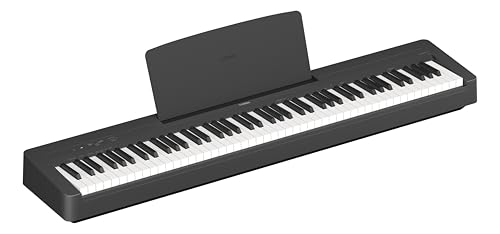
Yamaha P-145
Beginners who want the current Yamaha entry model with app control and a slim footprint
Read the Yamaha P-145 review →Head-to-Head Comparisons
- Ktaxon Foldable 88-Key vs Wencai C01 Compare →
Questions Buyers Ask
Wencai C01
See the current listing, price and included accessories.
About This Review
Mandrillis Team
The Mandrillis editorial team researches and compares audio and music gear using manufacturer documentation, verified specs and real buyer feedback, so you can make a confident purchase without wading through marketing claims.
Read our full research methodology.