Digital Pianos Review
Melentro 88-Key Desk Piano Review: Budget Hammer Action
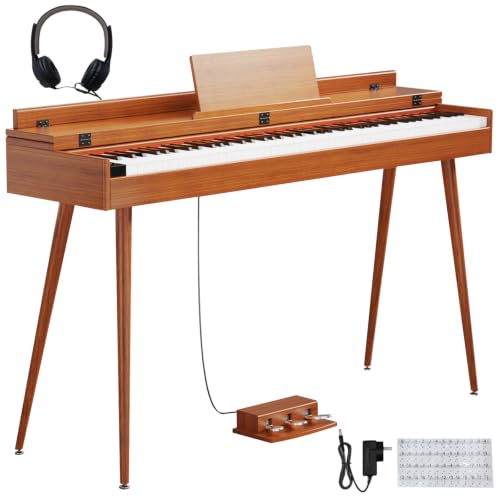
A budget 88 key hammer action digital piano that converts into a desk or vanity. The listing highlights 128 note polyphony, 800 tones, 25 watt speakers, USB MIDI, MP3 playback and a three pedal unit. Weight and Bluetooth are not published.
Our Verdict
Research Score 62/100The Melentro 88-Key Desk Piano is an ambitious budget product that pairs a hammer action 88 key instrument with a desk and vanity cover. On paper it offers 128 note polyphony, 800 tones, 25 watt speakers, USB MIDI, MP3 playback, a stand and a three pedal unit. The main tradeoff is uncertainty: the listing omits weight, dimensions, action supplier, sensor count, sound engine and Bluetooth details. For a beginner who wants a dual purpose furniture piano and accepts these unknowns, it is a reasonable value. Score 62 out of 100.
Editorial research score based on published specifications and documented features, not a customer rating or lab test.
Melentro
Melentro 88-Key Desk Piano
Best for: Buyers who want an 88 key hammer action piano that doubles as a compact desk or vanity in a smaller room.
Skip it if: You need a portable slab keyboard with published weight and a proven action from a major manufacturer.
Check Price on AmazonWe may earn a commission at no extra cost to you.
Listing verified: October 2026
Who Should Buy It
Buy it if
- A beginner or casual player wanting a full size hammer action keyboard on a strict budget
- Someone with limited space who can use the piano as a desk or vanity when closed
- A buyer who values an included stand and three pedal unit out of the box
- A hobbyist who wants a high tone count and basic USB MIDI recording without extra gear
Skip it if
- You need Bluetooth audio or Bluetooth MIDI, which is not published in the listing
- You plan to move the piano often and need a clearly listed weight and compact depth
- You want a graded action with published sensor details from an established piano brand
Key Specifications
| Keys | 88 keys |
| Key action | Hammer action, full weighted keys |
| Polyphony | 128 notes |
| Sounds | 800 tones |
| Speakers | 25W x 2 |
| Connectivity | USB/MIDI, USB audio playback |
| Bluetooth | Not published in listing |
| Pedals included | Three pedal unit |
| Weight | Not published in listing |
| Included accessories | Stand, three pedal unit |
Overview
The Melentro 88-Key Desk Piano is a budget tier digital piano that combines an 88 note weighted keyboard with a furniture style desk cover. The listing describes a full size hammer action instrument that can be closed to become a tabletop or vanity, making it different from standard slab keyboards. This dual purpose design targets home offices, dorm rooms and smaller apartments where space is at a premium. The product is positioned as an all in one solution for a beginner who wants a piano without sacrificing floor space.
The published specification includes 128 note polyphony, 800 tones, a 25 watt per side speaker system and a three pedal unit. The product listing does not state the exact weight, dimensions or the name of the key action supplier. That missing information is important for buyers who need to move the instrument or compare it directly with entry level models from better known brands. Even so, the on paper feature set is unusually broad for the budget tier.
This review only uses the data from the product listing and general knowledge about digital piano technology. No direct testing or measured analysis is claimed. The goal is to interpret the published facts and highlight what remains unknown.
Key Action
The keyboard is advertised as an 88 key full size, weighted, hammer action instrument. This type of action is meant to mimic the resistance of an acoustic piano, which is useful for beginners who are still developing finger strength and control. The listing says the keys are weighted, but it does not specify whether the action is graded or whether it uses triple sensors, dual sensors or a particular mechanical design. Those details are often mentioned by established piano brands when they describe their own actions.
On paper, this separates the Melentro from many budget models that use unweighted or semi weighted keys. However, entry level pianos such as the Yamaha P-145, Roland FP-10, Casio PX-S1100 and Kawai ES120 publish more detail about their action technologies, including sensor counts and graded weighting. The Melentro listing only confirms hammer action and full weighted keys, so buyers cannot tell how evenly the action responds, how much key noise it makes, or how it will hold up over years of daily practice.
For a beginner, the presence of 88 hammer action keys is a positive sign at this price tier. The main risk is that the action may feel heavier or lighter than expected, with no published downweight or return speed. Without direct evaluation, the sensible conclusion is that this action is likely adequate for basic learning, but it should not be expected to match a premium graded action. Buyers who prioritize a refined piano feel will likely look toward models from brands with a longer track record.
Piano Sound and Speakers
The product listing claims a sophisticated chip that accurately simulates the sound of a real piano, supported by 128 note polyphony. That polyphony count is generous for the budget tier and means sustained passages should not drop notes as quickly as on cheaper instruments. The listing also mentions 800 tones, which is far more than the small handful of sounds on most entry level digital pianos. This broad tone library can appeal to hobbyists who want organ, strings, synth and other textures.
The sound engine is not identified by name, and the listing does not specify whether the main piano sample is multi layered, how long the samples are, or whether there are sympathetic resonance and damper resonance effects. These are the areas where budget no name models often fall short compared to instruments from Yamaha, Roland or Kawai. The 25 watt per side speaker system is also a useful step up from built in 6 to 10 watt systems on many compact slabs, but volume does not guarantee clarity or realism.
Buyers should expect the piano sound to be serviceable for practice and casual enjoyment, especially with the 128 note polyphony and speaker wattage. The 800 tone count adds variety, which may keep a beginner engaged. Still, the lack of a named sample engine means the sound quality is unknown on paper, and it would be wise to listen to owner recordings before buying. The listing does not state the sampling resolution or whether the main piano sound uses stereo samples.
Features and Modes
The control panel is described as multi functional, with tone selection, sound recording control and a double keyboard split function to help beginners. The listing says the panel clearly displays functions so you can track your progress, but it does not specify whether the display is an LED segment screen, a small backlit LCD or something else. There is also no mention of a companion app for deeper editing or lessons. Split mode can divide the keyboard into two ranges, which is useful for teacher and student side by side.
USB support allows MP3 playback, according to the listing, so you can play along with audio files over the piano speakers. USB MIDI connectivity lets the keyboard connect to a computer or supported mobile device for use with software instruments and recording apps. However, the listing does not state whether the USB port supports class compliant MIDI on tablets or requires drivers, and there is no mention of Bluetooth audio, Bluetooth MIDI or an audio input. These omissions are common at the budget tier, but they limit wireless connectivity options.
The recording control suggests you can capture your playing and listen back, which is a helpful learning tool. The listing does not say how many songs can be stored or whether recording is done as MIDI, audio or both. Without that detail, the recording feature is only partially described. Buyers should not expect a deep onboard song library or lesson system based on the current information.
- 800 tones with tone selection
- Sound recording control
- Double keyboard split for lesson use
- USB MIDI for computer integration
- USB MP3 playback
- Display type not specified in listing
Build, Design and Portability
The most distinctive design feature is the closing lid that converts the piano into a desk or vanity. This makes the Melentro a furniture piece rather than a portable keyboard. The listing positions it for home offices, dorm rooms and apartments. The included stand is part of that design, so the instrument is meant to stay in one place rather than be moved between gigs or lessons.
The product listing does not publish the weight or dimensions, which is a notable omission for a piece that combines a piano and desk. Buyers should assume it will be heavier and deeper than a typical slab digital piano, especially with a full 88 key chassis and 25 watt speakers. The three pedal unit is included, so the bottom footprint must also accommodate a fixed pedal position. Without dimensions, it is difficult to know if the desk height matches a standard chair.
The build quality is unknown from the listing, but the budget price tier suggests that the cabinet materials may include particle board or plastic rather than solid wood. The vanity function indicates a flat surface when closed, but the listing does not say how much weight the desk can support or how the lid hinges hold up over time. This is fine for a stationary practice corner, but less suitable for heavy travel. Buyers should also consider whether the desk surface is scratch resistant enough for daily use.
Connectivity
The published connectivity includes USB and MIDI, which should cover basic recording and practice with a computer. The listing says USB support allows MP3 playback, meaning you can play audio files through the piano speakers, likely from a USB flash drive or a connected device. That is a convenience for play along practice, though the supported file formats and folder navigation are not described. A USB port that supports both MIDI and audio data is a practical addition at this price.
What is missing is any mention of Bluetooth, an auxiliary input, line outputs, or a headphone jack. Bluetooth is now common on digital pianos in this range, but it is not listed here, which suggests it is absent. A headphone jack is likely present on many digital pianos but the listing does not confirm it, so buyers who need silent practice should verify before purchase. The absence of line outputs means you cannot easily connect to an external amplifier or recording interface without relying on USB.
For a home practice instrument, USB MIDI is adequate for connecting to a DAW, virtual piano software or a notation editor. The lack of Bluetooth audio streaming may matter less to a beginner than to someone who wants to play along with phone apps without cables. Overall, the connectivity is solid but basic, and the omissions are not clearly compensated by any other connections. A headphone jack would be especially important for dorm or apartment use.
Setup and Accessories
The listing states that a stand and a three pedal unit are included. That removes two of the most common extra purchases for a beginner. The three pedal unit typically provides soft, sostenuto and sustain functions, matching the pedal complement of an acoustic piano. The listing does not describe the pedal materials or whether the sustain pedal supports half pedaling. Half pedaling is often missing on budget models, but it is not mentioned here at all.
Assembly is likely required, because the desk style cabinet and stand must be put together. The listing does not include a bench, so buyers will need to provide their own seat. There is also no mention of a dust cover, headphones, a power adapter in the box, or a printed manual. Usually a power adapter is included with a home digital piano, but the listing should be checked for that detail. The desk lid may serve as a dust cover when closed, but a separate fabric cover is not mentioned.
The dual function desk cover means there is no separate slip cover or music rest to attach, which simplifies the design. The product listing does not say whether the music rest is integrated into the desk lid or whether sheet music can stand on the closed top. This is a minor point, but again the listing leaves some practical accessory details unpublished. A buyer who wants a complete out of box experience may need to purchase a bench and headphones separately.
Daily Use
During daily practice, the Melentro functions as a full size piano with 88 weighted keys and a three pedal unit, which is close to the experience of an acoustic piano. The 128 note polyphony means long sustained chords and complex passages should not cut off prematurely. The closing lid allows the room to change function quickly, which is useful in a dorm or home office. A player can close the lid after practice and use the surface for a laptop, books or personal items.
The multi function panel offers tone selection, recording and split mode, so a beginner can record a simple piece and listen back. USB MP3 playback supports play along practice, and the speakers should fill a small or medium room. That said, the lack of published action detail and sound engine name means the practice experience may be inconsistent from unit to unit. The listing does not mention key sensitivity settings or velocity curves, which could affect how the piano responds to different playing styles.
For silent practice, a headphone jack is not clearly listed, which is a risk for anyone sharing a small space. If the piano does have a headphone output, it would be a standard 1/4 inch or 1/8 inch jack, but the listing does not say. Buyers who need quiet practice should confirm this before buying, or be prepared to rely on the built in speakers at low volume. The absence of a published headphone spec is a notable drawback for dorm and apartment use.
Who Should Buy It
The Melentro 88-Key Desk Piano is best for a beginner or casual player who wants a furniture style instrument without paying a premium price. The desk conversion adds real utility in a bedroom, dorm or studio apartment. The included stand and three pedal unit lower the total cost of getting started. A buyer who has never played a weighted keyboard may find the hammer action acceptable for learning basic finger technique.
It also suits a hobbyist who likes the idea of 800 tones and USB MIDI for experimentation. If you are not concerned about a named key action or a proven piano sample engine, the on paper feature list is strong for the budget tier. Buyers should be comfortable with some unknown specifications and potentially limited local support. The dual purpose design is a unique selling point that no basic slab piano offers.
This is not the best choice for a performer who needs a lightweight, durable stage keyboard or for someone who requires Bluetooth and a published weight. For those buyers, established slab pianos from major brands offer more documentation and predictable performance. A buyer who prioritizes a refined graded action will likely be happier with a Yamaha P-145 or Roland FP-10, even if those models have fewer tones.
Verdict
The Melentro 88-Key Desk Piano is an ambitious budget product that combines a hammer action 88 key instrument with a desk and vanity cover. On paper, it offers a strong feature set for the price tier: 128 note polyphony, 800 tones, 25 watt speakers, USB MIDI, MP3 playback, a stand and a three pedal unit. Those numbers are unusual at the low end and make the piano look competitive against more established entry level models.
The tradeoff is uncertainty. The listing does not publish the weight, dimensions, action manufacturer, sensor count, sound engine name, Bluetooth support, headphone jack or key noise behavior. That is a lot of missing information. Entry level models from Yamaha, Roland, Casio and Kawai may have fewer features or a higher price, but their specifications and support are more transparent. For a beginner who simply wants a piano that does not take over the room, the Melentro may be sufficient.
Given the budget tier and the unknown build quality, the Melentro earns a score of 62 out of 100. It is a reasonable gamble for a home beginner who values the desk conversion and will accept a basic action and sound. If you can try one in person or buy from a seller with a good return policy, it may be a practical dual purpose addition to a small room. Buyers who need published weight, Bluetooth or a proven action should look elsewhere.
Strengths and Limitations
Strengths
- 88 hammer action weighted keys at a budget tier
- 800 tones and 128 note polyphony on paper
- Desk cover design saves space
- 25W x 2 speaker system
- USB MIDI and USB MP3 playback
- Stand and three pedal unit included
Limitations
- Weight and dimensions not published in listing
- No Bluetooth audio or Bluetooth MIDI listed
- No named key action or sound engine details
- Unproven long term build quality for a budget desk piano
- Split and recording features lack detail
How We Scored It
Scores reflect published specifications, documented features and value against the alternatives below. They are editorial research scores, not laboratory measurements.
Alternatives to Consider

Donner DDP-80
Buyers who want a good-looking console with weighted keys for a living room at the lowest price
Read the Donner DDP-80 review →
Alesis Recital Home
Families who want a complete budget console with hammer keys and three pedals in one box
Read the Alesis Recital Home review →
Casio Privia PX-770
Students who want a three-pedal console with a three-sensor action at the lowest Privia price
Read the Casio Privia PX-770 review →Questions Buyers Ask
Melentro 88-Key Desk Piano
See the current listing, price and included accessories.
About This Review
Mandrillis Team
The Mandrillis editorial team researches and compares audio and music gear using manufacturer documentation, verified specs and real buyer feedback, so you can make a confident purchase without wading through marketing claims.
Read our full research methodology.