Casio Privia PX-S3100 vs Yamaha P-145
Quick Verdict
The Casio Privia PX-S3100 and Yamaha P-145 are close, scoring 85 and 84. Choose the Casio if you want 700 tones, 200 rhythms, pitch bend, assignable knobs, USB flash-drive audio recording and battery operation. Choose the Yamaha if you want a focused piano with a slightly higher rated GHC graded hammer action, Smart Pianist app control, Bluetooth audio play-along and a slim footprint. The Casio suits performers and songwriters. The Yamaha suits beginners and piano-only players who value simplicity and graded action over feature count. Both are strong digital pianos.

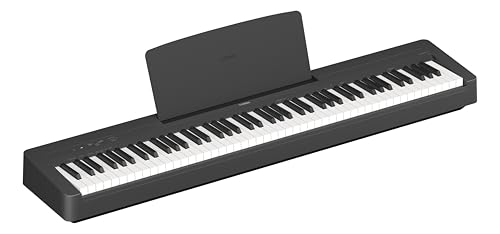
| Spec | Casio Privia PX-S3100 | Yamaha P-145 |
|---|---|---|
| Key Action | Smart Scaled Hammer Action | GHC (Graded Hammer Compact) |
| Sound Engine | Casio AiR with resonance | Yamaha CFX sample |
| Voices | 700 | 10 |
| Polyphony | 192 notes | 64 notes |
| Speakers | 2 x 8 W | 2 x 7 W |
| Bluetooth | Audio and MIDI via included WU-BT10 adapter | Audio (this listing) |
| USB | USB to Host; USB flash-drive audio recording | USB to Host (MIDI and audio) |
| Pedals | Sustain pedal included; SP-34 triple pedal optional | Sustain footswitch included |
| Weight | 25.1 lb (11.4 kg) | 24.5 lb (11.1 kg) |
| Form Factor | Ultra-slim portable, battery capable | Portable slab, slim depth |
Key Action
The Casio Privia PX-S3100 uses Casio's Smart Scaled Hammer Action. The listing describes this as the same light Smart Scaled action found in the PX-S1100, and the con notes call it light. Casio scores this action 24 out of 30.
The Yamaha P-145 uses the GHC, or Graded Hammer Compact, action. The listing says GHC keeps a graded hammer feel in a shallower keybed, and Yamaha scores this action 25 out of 30. This is one point higher than the Casio.
Both keybeds are hammer actions designed for slim digital pianos, but Yamaha emphasizes a graded feel while Casio's Smart Scaled action is described as lighter. If traditional piano response matters most, the Yamaha holds a small scoring edge.
Piano Sound and Speakers
The Casio Privia PX-S3100 runs the Casio AiR sound engine with resonance. It provides 192-note polyphony and 700 voices through two 8 watt speakers. Casio scores its piano sound 22 out of 25.
The Yamaha P-145 uses a Yamaha CFX sample with 64-note polyphony and 10 voices. Its speakers are two 7 watt units, and Yamaha scores its piano sound 20 out of 25. The listing does not state a resonance feature for the P-145.
The Casio leads in polyphony, voice count and speaker wattage, and its sound score is two points higher. The Yamaha's CFX sample is a focused piano sound, but the Casio offers more flexibility for layered and split sounds.
Features and Modes
The Casio Privia PX-S3100 includes 700 tones, 200 accompaniment rhythms, a pitch bend wheel, two assignable knobs, USB flash-drive audio recording and a Bluetooth audio and MIDI adapter. It is also battery capable. Casio gives it a perfect features score of 15 out of 15.
The Yamaha P-145 has 10 voices and Bluetooth audio on this version. The Smart Pianist app turns a phone into the control panel, and USB to Host handles MIDI and audio. Yamaha scores it 11 out of 15 for features.
The Casio is a full arranger and performance instrument in a slim piano case. The Yamaha stays intentionally simple with a small voice set and app based control, which may be enough for practice but not for arranging or stage use.
Build, Design and Portability
The Casio Privia PX-S3100 weighs 25.1 lb or 11.4 kg and has an ultra-slim portable form factor. It is battery capable, and the listing notes it shares the same 232 mm deep case as the PX-S1100. Casio scores build and portability 10 out of 10.
The Yamaha P-145 weighs 24.5 lb or 11.1 kg and is described as a portable slab with slim depth. The listing does not state battery operation for the Yamaha. Yamaha also scores 10 out of 10 for build and portability.
Both models are extremely close in weight, with the Yamaha just 0.6 lb lighter. The Casio adds battery capability, which makes it more flexible for outdoor use or places without power.
Connectivity
The Casio Privia PX-S3100 has Bluetooth audio and MIDI through the included WU-BT10 adapter, USB to Host, and USB flash-drive audio recording. A sustain pedal is included, and the SP-34 triple pedal is optional. Casio scores connectivity 9 out of 10.
The Yamaha P-145 lists Bluetooth audio, USB to Host for MIDI and audio, and an included sustain footswitch. Its con list notes that the headphone jack doubles as the sole audio output. Yamaha scores connectivity 8 out of 10.
The Casio adds Bluetooth MIDI, USB flash-drive recording and an optional triple pedal, which the Yamaha does not list. Yamaha's single audio output may limit connecting to external speakers or mixers without a computer.
Setup and Accessories
The Casio Privia PX-S3100 comes with a sustain pedal and the WU-BT10 Bluetooth adapter. The SP-34 triple pedal is sold separately. The touch panel has more functions and is noted as busier, so setup and daily control may take more time.
The Yamaha P-145 includes a sustain footswitch and uses the Smart Pianist app as the main control panel. The listing states Bluetooth audio but does not mention a separate adapter, which suggests built-in Bluetooth audio.
Both include a basic sustain pedal or footswitch. Neither listing states that a stand or bench is included. Casio includes an adapter for Bluetooth MIDI, while Yamaha relies on app based setup for its simpler feature set.
Daily Use
The Casio Privia PX-S3100 suits daily use as an arranger and performance keyboard. The 700 tones and 200 rhythms cover a wide range of styles, and the assignable knobs and pitch bend wheel add real time control. The trade off is a busier touch panel and small speakers for the arranger content.
The Yamaha P-145 is built for straightforward piano practice. The GHC action provides a graded hammer feel, and the Smart Pianist app keeps controls out of the way. Bluetooth audio lets you stream play-along tracks, but the 10 voices and 64-note polyphony limit advanced layering.
The Deciding Question
The main question is whether you need a wide palette of sounds and accompaniment features. If you want 700 tones, 200 rhythms, pitch bend, knobs and USB flash-drive recording, the Casio Privia PX-S3100 is the clear choice.
If you only need a piano and value a graded hammer action, simple app control and Bluetooth audio play-along, the Yamaha P-145 is the better match. The overall scores are close at 85 and 84, but the Casio wins on features while the Yamaha wins on key action and value score.
Who Should Buy Which
Choose the Casio Privia PX-S3100 if you are a performer, songwriter or arranger who wants the slim PX-S1100 case loaded with 700 tones, 200 rhythms, pitch bend, knobs, USB audio recording and battery operation. Avoid it if you only play piano and would rather put money toward action or speakers.
Choose the Yamaha P-145 if you are a beginner or piano focused player who wants the current Yamaha entry model with GHC graded hammer action, Smart Pianist app control, Bluetooth audio play-along and a slim footprint. Avoid it if you need 192-note polyphony, line outputs or a richer voice set.
Casio Privia PX-S3100
Pros
- 700 tones and 200 rhythms in the same slim case as the PX-S1100
- Pitch bend wheel and two assignable knobs
- Audio recording to a USB flash drive
- Bluetooth audio and MIDI adapter included, battery capable
Cons
- Same light Smart Scaled action as the PX-S1100
- Touch panel is busier with more functions
- Speakers are small for an arranger
Yamaha P-145
Pros
- Slimmer and lighter than the P-45 it replaces
- GHC action keeps a graded hammer feel in a shallower keybed
- Smart Pianist app turns a phone into the control panel
- Bluetooth audio on this version lets you stream play-along tracks
Cons
- Still 64-note polyphony
- Only ten voices
- Headphone jack doubles as the sole audio output
Who Should Buy Each
Casio Privia PX-S3100
- You write and perform with backing rhythms and need many sounds
- You want pitch bend and knobs for synth and organ parts
- You record practice or performances to a USB stick
Yamaha P-145
- You are buying a first piano and want the newest entry-level Yamaha
- Space is tight and you need a shallow, light instrument
- You practice with play-along tracks from a phone
Quick Decision Guide
| If you need 700 tones and 200 accompaniment rhythms | Choose Casio Privia PX-S3100 |
| If you want graded hammer feel in a shallower keybed | Choose Yamaha P-145 |
| If you need Bluetooth MIDI and USB flash-drive audio recording | Choose Casio Privia PX-S3100 |
| If you want Smart Pianist app control and Bluetooth audio play-along | Choose Yamaha P-145 |
| If you only play piano and value a simple focused instrument | Choose Yamaha P-145 |
FAQ
About This Comparison
Mandrillis Team
The Mandrillis editorial team researches and compares audio and music gear using manufacturer documentation, verified specs and real buyer feedback, so you can make a confident purchase without wading through marketing claims.
Read our full research methodology.
We may earn a commission at no extra cost to you.