Boss Katana-Mini X vs Melonare MA-8 Acoustic Amp
Quick Verdict
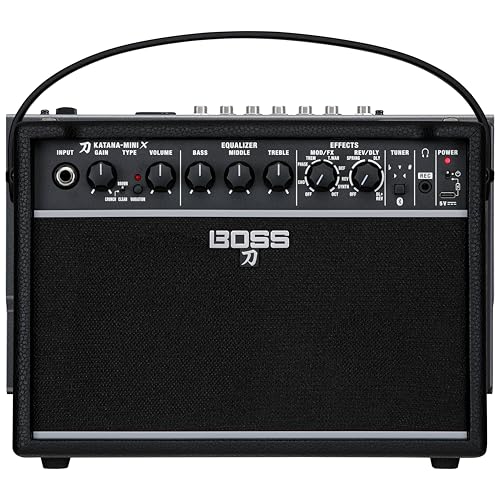
The Boss Katana-Mini X is the better choice for electric guitar and bass players who want multiple amp models, built-in effects, and Bluetooth audio streaming in a compact practice amp. Its nine Katana variations and flat-response setting cover more ground than the Melonare MA-8, which has no amp models and only reverb. However, the Melonare is lighter at 2.3 kg, has a rechargeable battery, separate mic and instrument channels, and USB OTG recording. Choose the Boss for tone shaping and electric versatility. Choose the Melonare for acoustic vocal practice, portable play, and quick recording without a computer.

| Spec | Boss Katana-Mini X | Melonare MA-8 Acoustic Amp |
|---|---|---|
| Power output | 10 watts | 80W peak (as listed) |
| Speaker | Custom 5-inch speaker | Dual 78 mm x 24 mm drivers with passive bass radiators in a sealed, port-free cabinet |
| Amp models or channels | Brown, Crunch, and Clean amp types, each with three variations (nine total); includes a flat-response variation for acoustic-electric guitar and bass | Two input channels: 6.35 mm instrument and mic; no amp models published |
| Effects | Two independent effect sections with 10 total effect types | Separate mic and instrument reverb controls |
| Inputs and outputs | Not published in listing | 6.35 mm instrument input, mic input, USB/SD card, AUX input, USB OTG recording |
| Headphone and line out | Not published in listing | Not published in listing |
| Bluetooth and app | Onboard Bluetooth for audio streaming; no app mentioned in listing | Wireless playback mode mentioned; Bluetooth version and app support not published |
| Weight | Not published in listing | 2.3 kg |
| Dimensions | Not published in listing | Not published in listing |
| Included accessories | Not published in listing | Storage bag, wired microphone, recording cable, charging cable, key accessories |
Amp Models and Tone
Boss Katana-Mini X offers three Katana amp types: Brown, Crunch, and Clean, each with three variations, making nine total amp voicings. The listing also states a flat-response variation for acoustic-electric guitar and bass. A three-band analog EQ further shapes the sound. The score for tone and amp models is 26 out of 30.
Melonare MA-8 Acoustic Amp does not publish amp models or emulations. It has two input channels, a 6.35 mm instrument input and a mic input. The focus is clean acoustic reproduction rather than modeled overdrive or crunch. Separate mic and instrument reverb controls and a two-band EQ allow basic tone shaping, giving a tone score of 20 out of 30.
For acoustic players, the Boss flat-response variation can work, but the Melonare is designed specifically for that use. For electric guitar, the Boss clearly offers more tonal variety. Neither amp models acoustic resonance in detail, but the Boss's nine variations are more flexible than the Melonare's clean-only approach.
Effects and Features
Boss has two independent effect sections with 10 total effect types. The listing does not disclose specific effect names or routing options. It includes a built-in tuner and Bluetooth audio streaming. These features add convenience for practice and give the effects and features score of 15 out of 20.
Melonare has separate mic and instrument reverb controls as its primary effect. It does not list modulation, delay, or other effect types. It includes USB/SD card playback, AUX input, and USB OTG recording. These are functional features but not traditional guitar effects, giving a score of 12 out of 20.
Boss's two effect sections likely provide more sound shaping than Melonare's reverb-only approach. However, Melonare's recording and playback features can be more useful for acoustic singer-songwriters. The choice depends on whether you want effect variety or recording convenience.
Power, Speaker and Volume
Boss uses a 10-watt power section and a custom 5-inch speaker. The listing does not state whether this rating is RMS or peak, and the power source is not published. The 5-inch speaker is suitable for close-range practice but not for competing with drums or a full band. The power and speaker score is 10 out of 15.
Melonare lists 80W peak power, with no RMS figure provided. The speaker system uses dual 78 mm x 24 mm drivers with passive bass radiators in a sealed, port-free cabinet. These drivers are quite small, which may limit low-end projection. The rechargeable battery provides 4 to 6 hours runtime, and the power and speaker score is 9 out of 15.
The Melonare's peak power rating suggests it may get louder than the Boss in a small room, but the tiny drivers likely cannot match the Boss's 5-inch speaker for full-range tone. Both are best used at moderate volumes in small spaces. Neither amp is designed for medium or large venues.
Build and Portability
Boss uses a durable wood cabinet, according to the listing. The weight and dimensions are not published. The lack of these specs makes portability hard to evaluate precisely, but the compact design and 5-inch speaker suggest a small footprint. The build and portability score is 7 out of 10.
Melonare weighs 2.3 kg, which is quite light. Dimensions are not disclosed. It includes a storage bag, which aids transport. The lightweight build and included bag make it easy to carry, giving a build and portability score of 7 out of 10.
Both amps score the same on build and portability, but for different reasons. Boss's wood cabinet may feel more solid, while Melonare's confirmed light weight and bag are practical advantages. Without Boss's weight and dimensions, direct comparison is incomplete.
Connectivity and Apps
Boss includes onboard Bluetooth for audio streaming. No mobile app is mentioned in the listing. Inputs and outputs are not published, and the listing does not confirm a headphone or line out. This limits our ability to evaluate silent practice or recording options, giving a connectivity score of 8 out of 15.
Melonare lists a 6.35 mm instrument input, a mic input, USB/SD card, AUX input, and USB OTG recording. It also mentions a wireless playback mode, but the Bluetooth version and app support are not published. Headphone and line out are not published. The connectivity score is 10 out of 15.
Melonare clearly offers more physical connectivity options for playback and recording. Boss offers Bluetooth audio streaming but omits input and output details. If you need to connect a microphone or record to a phone, Melonare is the more transparent choice based on published information.
Setup and Daily Use
Boss has a simple front panel with amp type selection, a three-band EQ, and two effect sections. The built-in tuner is handy for daily practice. Bluetooth audio streaming lets you play along with songs from a phone or tablet. Setup should be straightforward, but the power source is not listed.
Melonare uses separate channels for instrument and microphone, each with its own reverb control. The multiple playback inputs mean you can plug in a USB drive or SD card. The rechargeable battery eliminates the need for a wall outlet in many situations. Daily use for acoustic practice or karaoke is a key strength.
For electric players, Boss's amp models and tuner make it easy to get a usable sound quickly. For acoustic players who sing, Melonare's separate mic channel and portable battery are practical. Both amps appear easy to operate, but Boss's missing power source details add uncertainty.
Home Practice Versus Stage
Neither amp is a stage amplifier. The Boss Katana-Mini X is rated at 10 watts with a 5-inch speaker, appropriate for bedroom, apartment, or late-night practice. It would likely struggle to be heard over acoustic drums or in a band mix.
The Melonare MA-8 lists 80W peak, but its dual 78 mm x 24 mm drivers and passive radiators are not designed for high sound pressure levels. It may work for small acoustic gatherings, family sing-alongs, or outdoor picnics. However, it lacks a line out for connecting to a PA system.
For home practice, both are well suited. For any stage use, even a small coffee shop gig, you would likely need to mic the amp or use a direct box. The Boss's lack of output details and Melonare's missing headphone and line out are both limitations for silent practice or live integration.
The Deciding Question
The key question is whether you need versatile amp modeling for electric, acoustic, and bass, or a lightweight acoustic amp for vocals and instrument. The Boss Katana-Mini X is built around the Katana amp legacy, with nine amp variations, a flat response, and two effect sections. The Melonare MA-8 is a clean platform with separate mic and instrument inputs, reverb, and recording features.
Another deciding factor is connectivity and power. Boss offers Bluetooth audio streaming but omits input and output details. Melonare has a built-in rechargeable battery, USB OTG recording, and multiple playback options. If you want to capture ideas quickly or play untethered, Melonare has clear advantages.
Finally, consider the missing specifications. Boss does not publish weight, dimensions, power source, or input/output configuration. Melonare omits dimensions, headphone/line out, and Bluetooth version. Both listings have gaps, but Melonare's lighter weight and included accessories are confirmed.
Who Should Buy Which
Choose the Boss Katana-Mini X if you are primarily an electric guitar or bass player who wants multiple amp voicings and effects in a small practice amp. The three Katana types, nine variations, flat response, and two effect sections are the main draws. Bluetooth audio streaming and a built-in tuner add daily convenience. The lack of detailed specs means you should verify power and connectivity before buying.
Choose the Melonare MA-8 Acoustic Amp if you play acoustic guitar and sing, or if you want a portable battery-powered amp for casual use. The separate mic and instrument channels, reverb controls, USB OTG recording, and included wired microphone make it a ready-to-use package. The 2.3 kg weight and storage bag are practical for travel.
Overall, the Boss scores higher at 74 out of 100 versus the Melonare's 65 out of 100, but the scores reflect different priorities. The Boss wins on tone modeling and effects, while the Melonare wins on connectivity and portability. Your choice should match your instrument and practice style.
Boss Katana-Mini X
Pros
- Compact 10-watt design for electric, acoustic, and bass
- Three Katana amp types with nine total variations
- Three-band analog EQ for precise tone shaping
- Two effect sections with 10 effect types
- Built-in tuner and Bluetooth audio streaming
- Durable wood cabinet with custom 5-inch speaker
Cons
- Listing omits weight, dimensions, and input/output details
- No app or deep editing features appear in the product listing
- 10 watts and 5-inch speaker limit live or band use
- No specific effect names or routing options are disclosed
- Power source and included accessories not published
Melonare MA-8 Acoustic Amp
Pros
- Portable and lightweight at 2.3 kg
- Separate reverb controls for mic and instrument
- OTG recording for phone or tablet capture
- Multiple playback sources including wireless, USB, SD, AUX
- Rechargeable battery with 4 to 6 hours runtime
- Includes storage bag, wired mic, and cables
Cons
- No published headphone or line out
- No app support or detailed Bluetooth version
- Peak power rating only, no RMS figure
- Speaker drivers are very small for low-end projection
- Dimensions not disclosed in listing
Who Should Buy Each
Boss Katana-Mini X
- Beginners and students wanting a simple practice amp with a tuner
- Players who need one mini amp for electric, acoustic, and bass
- Anyone who wants Bluetooth play-along and Katana tone at a budget price
- Home and bedroom players with limited space
Melonare MA-8 Acoustic Amp
- Acoustic guitar players who mainly practice at home or in small rooms
- Singers and hosts who want a portable mic and guitar amp for casual gatherings
- Songwriters who want to capture ideas quickly through USB OTG recording
- Travelers and campers who need a lightweight rechargeable speaker for music playback
Quick Decision Guide
| If you primarily play electric guitar or bass and want Katana-style amp models and effects | Choose Boss Katana-Mini X |
| If you play acoustic guitar and sing and need a portable battery-powered amp with separate mic input | Choose Melonare MA-8 Acoustic Amp |
| If you want Bluetooth audio streaming and a built-in tuner for play-along practice | Choose Boss Katana-Mini X |
| If you need USB OTG recording, SD card playback, and included wired microphone | Choose Melonare MA-8 Acoustic Amp |
| If you want the lightest amp with a storage bag for travel | Choose Melonare MA-8 Acoustic Amp |
FAQ
About This Comparison
Daniel Brooks
Daniel Brooks edits the buying guides and how-to articles at Mandrillis. He works from manufacturer manuals, published specifications and common owner questions to explain music and audio gear in plain language, from turntables and headphones to digital pianos and electronic drums.
Read our full research methodology.
We may earn a commission at no extra cost to you.