Boss Katana-Air vs Fender Champion II 100 Blackout
Quick Verdict
The Boss Katana-Air is the better choice for guitarists who want a compact, wire-free home practice amp with Katana modeling and a low latency wireless transmitter. Its 30-watt stereo 2 x 3-inch speaker system, five amp characters, over 50 effects and six onboard memories suit apartment and travel use. The Fender Champion II 100 Blackout is the better choice for players who need a 100-watt dual 12-inch combo for rehearsal and small to medium stages. It includes four amp voicings, built-in effects with tap tempo, an effects loop, USB and a footswitch. Choose the Boss for wireless desktop practice, the Fender for stage-friendly power and projection.
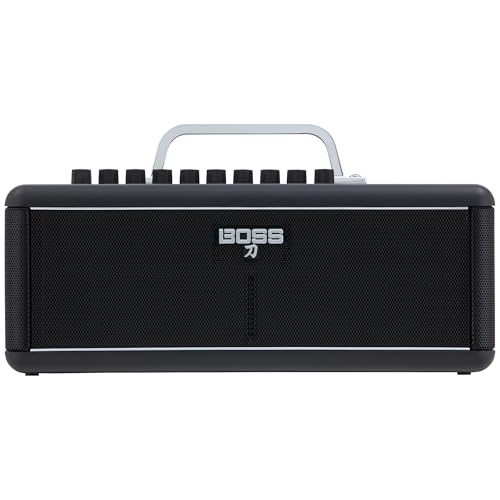

| Spec | Boss Katana-Air | Fender Champion II 100 Blackout |
|---|---|---|
| Power output | Up to 30 watts from the stereo speaker system | 100 watts |
| Speaker | 2 x 3-inch full-range speakers | Dual 12-inch Fender Special Design speakers |
| Amp models or channels | 2 channels with five unique Katana amp characters | Fender clean, overdrive, British and modern distortion voicings |
| Effects | Over 50 BOSS effects accessible; six onboard memories for setups | Reverb, delay/echo, chorus, tremolo, Vibratone and more with tap tempo |
| Inputs and outputs | Wireless guitar input via included transmitter; physical jack details not published in listing | Effects loop, USB port; full input/output set not published in listing |
| Headphone and line out | Not published in listing | Not published in listing |
| Bluetooth and app | Bluetooth connectivity included; app functions not detailed in listing | Not published in listing |
| Weight | Not published in listing | Not published in listing |
| Dimensions | Not published in listing | Not published in listing |
| Included accessories | Compact wireless transmitter; other included accessories not published in listing | 2-button footswitch (channel select and effects on/off) |
Amp Models and Tone
The Boss Katana-Air offers two channels with five unique Katana amp characters, according to the listing. The Fender Champion II 100 Blackout offers four amp voicings: Fender clean, overdrive, British and modern distortion. Both amplifiers provide a range of base tones without requiring external pedals. The Boss listing does not detail the names of its five characters beyond 'five unique Katana amp characters', while the Fender listing specifies each voicing type.
In the supplied scoring breakdown, the Boss earns 26 out of 30 for tone and amp models, and the Fender earns 25 out of 30. The close scores suggest both models perform well in this category on paper. The Boss has more amp characters, but the Fender names distinct voicings that cover classic clean and overdrive styles. The Boss uses two 3-inch full-range speakers, which may limit low end, while the Fender uses dual 12-inch speakers that suggest fuller low end and projection.
No in-person listening was performed for this comparison, so tonal character is based only on the published amp models and speaker specifications. Buyers who can try both amplifiers in person will get a better sense of how the small Boss speakers compare to the Fender dual 12-inch speakers. The amp model count alone does not determine which tone is better for a given player.
Effects and Features
The Boss Katana-Air includes over 50 BOSS effects accessible through the amplifier, and it has six onboard memories for storing amp and effects setups. The Fender Champion II 100 Blackout includes reverb, delay/echo, chorus, tremolo, Vibratone and more, with tap tempo on board. The Fender also includes a two-button footswitch for channel select and effects on/off, which the Boss listing does not mention. Both amps provide a built-in effects suite that can reduce the need for separate pedals.
The Boss scores 17 out of 20 for effects and features, while the Fender scores 15 out of 20. The Boss advantage comes from the sheer number of effects and the six onboard memories. The Fender advantage is tap tempo for time-based effects, although the listing states the coverage for all effects is unclear. Neither listing confirms whether all effects can be adjusted from the amp panel or require a companion app.
Power, Speaker and Volume
The Boss Katana-Air is rated at up to 30 watts from its stereo speaker system, using two 3-inch full-range speakers. The Fender Champion II 100 Blackout is rated at 100 watts and carries dual 12-inch Fender Special Design speakers. This is a substantial difference in power and speaker surface area. The Fender is clearly designed for higher volume and larger spaces than the Boss.
The Boss listing positions the amp for home practice, apartment playing and travel use, where lower volume is appropriate. The Fender listing positions the amp for practice, rehearsal and small to medium stages. Neither listing provides a decibel level or maximum volume specification, so headroom cannot be precisely compared. In the scoring breakdown, the Boss earns 11 out of 15 for power and speaker, and the Fender earns 13 out of 15.
Build and Portability
Neither listing publishes the weight or dimensions for the Boss Katana-Air or the Fender Champion II 100 Blackout. This omission makes direct portability comparison difficult. The Boss is described as a compact desktop amplifier with a docking wireless transmitter, suggesting a smaller footprint. The Fender is a 100-watt combo with two 12-inch speakers, which typically implies a larger and heavier cabinet, but the listing does not confirm weight.
Both models score 8 out of 10 for build and portability, according to the supplied breakdown. The Boss includes a compact wireless transmitter as an accessory, and the listing highlights motion sensing and docking. The Fender includes a two-button footswitch, which adds a practical accessory for stage use. Without published dimensions, buyers who plan to move the amp regularly should verify size and weight through other sources.
Connectivity and Apps
The Boss Katana-Air includes Bluetooth connectivity and a wireless guitar input via the included transmitter. The listing states that physical jack details are not published, and headphone and line out capabilities are not detailed. The Fender Champion II 100 Blackout includes an effects loop and a USB port, but the listing does not publish a full input and output set. Headphone and line out specifications are also not published for the Fender.
Bluetooth and app support are not stated for the Fender. For the Boss, Bluetooth is included, but app functions are not detailed in the listing. This means the Boss offers wireless audio and control workflows in principle, while the Fender offers wired USB and effects loop integration. The Boss scores 13 out of 15 for connectivity, and the Fender scores 10 out of 15.
The Fender's USB port and effects loop allow for recording and pedalboard expansion, according to the listing. The Boss's Bluetooth and wireless transmitter support cable-free playing, but the lack of published physical jacks leaves wired connectivity unclear. Neither model has a confirmed headphone output or line out in the listing.
Setup and Daily Use
The Boss Katana-Air includes a low latency wireless transmitter that docks and charges in the amp, and a motion sensing transmitter that wakes the amp from standby automatically. Six onboard memories allow a player to store and recall favorite amp and effects setups. These features make daily practice simpler because the guitar connects without a cable and the amp can sit on a desk. The listing does not detail the amp's power source or battery life.
The Fender Champion II 100 Blackout includes a two-button footswitch for channel select and effects on/off, which is useful during rehearsal and performance. Its built-in effects with tap tempo allow on-the-fly adjustment of time-based effects without reaching for the amp panel. Neither listing describes a detailed control panel layout, so exact setup steps cannot be compared. Both amplifiers are presented as plug-and-play with no complex initialization required.
The Boss's wireless transmitter requires charging, but the listing notes it docks and charges in the amp. The Fender's footswitch requires a cable connection, though the listing does not specify cable length or type. Daily use for the Boss revolves around wireless freedom and preset recall, while the Fender emphasizes footswitch control and on-board effects.
Home Practice Versus Stage
The Boss Katana-Air is explicitly best for home practice, apartment playing and travel use. Its 30-watt rating and compact stereo 3-inch speakers are suited to low and moderate volume playing in small rooms. The wireless transmitter eliminates a cable from the playing position, which is convenient in a home or travel setup. The Fender Champion II 100 Blackout is best for guitarists needing 100 watts and dual 12-inch speakers for practice, rehearsal and small to medium stages.
For silent practice, neither listing confirms a headphone output, so players who live in shared spaces should verify that feature separately. The Boss offers Bluetooth connectivity, which may support wireless audio playback, but the listing does not detail headphone or line out functionality. The Fender does not state Bluetooth or app support. The Boss's 30-watt stereo system is unlikely to compete with a live drummer, while the Fender's 100 watts and dual 12-inch speakers are more appropriate for band use.
The Deciding Question
The central decision between these two amplifiers is whether the player prioritizes a compact wireless practice tool or a powerful stage-ready combo. The Boss Katana-Air offers Katana modeling, over 50 effects, six memories and a wireless transmitter in a desktop format. The Fender Champion II 100 Blackout offers 100 watts, dual 12-inch speakers, four voicings and a footswitch for channel and effects control. These two value propositions target different use cases.
Both listings omit weight, dimensions and headphone or line out details, so those practical factors cannot settle the decision. The Boss omits physical input and output jack specifications, while the Fender omits Bluetooth and app support. Buyers should verify any missing feature that matters to them. The scoring difference is small, with the Boss at 82 and the Fender at 78, but the right choice depends on playing situation.
Who Should Buy Which
Choose the Boss Katana-Air if you are a home player, apartment dweller or traveler who wants a wire-free desktop amplifier. The included low latency transmitter, five Katana amp characters, over 50 effects, six onboard memories and 30-watt stereo speaker system are ideal for that context. Avoid the Boss if you need a stage amp with deep low end, loud clean headroom for a full band, or detailed physical connectivity options.
Choose the Fender Champion II 100 Blackout if you need a straightforward 100-watt solid-state combo with dual 12-inch speakers for rehearsal and small to medium stages. The four amp voicings, built-in effects with tap tempo, effects loop, USB and included footswitch make it a practical gigging package. Avoid the Fender if you require confirmed headphone output, Bluetooth app control or an ultra-light grab-and-go amp, because those specifications are not published in the listing.
Boss Katana-Air
Pros
- Includes a low latency wireless transmitter that docks and charges in the amp
- Five Katana amp characters and over 50 BOSS effects provide wide tonal range
- Stereo 2 x 3-inch speaker system with up to 30 watts for a compact unit
- Six onboard memories store favorite amp and effects setups
- Motion sensing transmitter wakes the amp from standby automatically
- Bluetooth connectivity supports wireless audio and control workflows
Cons
- Physical input and output jack specifications are not published in the listing
- No published weight or dimensions makes travel planning less precise
- Small 3-inch speakers may limit low end for heavier guitar tones
- Amp battery life when running on battery power is not stated
- Headphone and line out capabilities are not detailed
Fender Champion II 100 Blackout
Pros
- 100 watts into dual 12-inch speakers for full practice and stage volume
- Four amp voicings cover clean, overdrive, British and modern distortion
- Onboard effects with tap tempo reduce the need for pedals at rehearsal
- Included two-button footswitch handles channel and effects switching
- Effects loop and USB expand recording and pedalboard options
- Blackout cosmetic treatment gives a cohesive stage look
Cons
- Listing omits weight and dimensions for transport planning
- No published headphone or line out specification
- Bluetooth and app support are not stated
- Tap tempo coverage for all effects is unclear
- No dedicated acoustic or bass voicing mentioned
Who Should Buy Each
Boss Katana-Air
- Guitarists who want a wire free practice setup at a desk or table
- Bedroom and apartment players who need low volume with Katana amp models
- Traveling musicians who value a compact speaker system and docking transmitter
- Home recording and production support users who need Bluetooth connectivity
Fender Champion II 100 Blackout
- Electric guitar players seeking versatile amp voicings at a lower mid-range price
- Gigging musicians who need two 12-inch speakers for fuller projection
- Bedroom and rehearsal players who want onboard effects without a large pedalboard
- Recording home users who can use the rear USB port
Quick Decision Guide
| If you need a compact wireless amp for home, apartment or travel | Choose Boss Katana-Air |
| If you need 100 watts into dual 12-inch speakers for band practice or stage | Choose Fender Champion II 100 Blackout |
| If you want over 50 built-in effects and six onboard memories | Choose Boss Katana-Air |
| If you want an included footswitch for hands-free channel and effects switching | Choose Fender Champion II 100 Blackout |
| If you want tap tempo control for time-based effects | Choose Fender Champion II 100 Blackout |
FAQ
About This Comparison
Daniel Brooks
Daniel Brooks edits the buying guides and how-to articles at Mandrillis. He works from manufacturer manuals, published specifications and common owner questions to explain music and audio gear in plain language, from turntables and headphones to digital pianos and electronic drums.
Read our full research methodology.
We may earn a commission at no extra cost to you.