Boss Acoustic Singer Live LT vs Fender Acoustic 100
Quick Verdict
The Boss Acoustic Singer Live LT suits acoustic guitarists and singer-songwriters who need a compact dual-channel amp with confirmed XLR DI, phones/recording output, and specific feedback and EQ tools. Its 60-watt bi-amp design and Acoustic Resonance address common piezo and feedback issues. The Fender Acoustic 100 offers higher 100-watt power and Bluetooth streaming in a compact cabinet, but its I/O and effects are not fully published. Choose the Boss if direct connectivity and acoustic control matter most. Choose the Fender if you value extra volume and wireless playback and can confirm the missing specs before purchase.
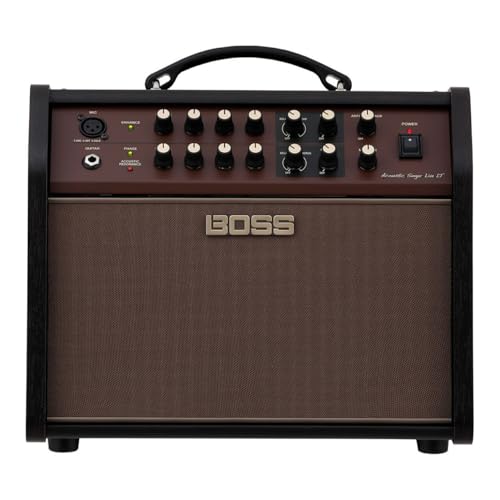
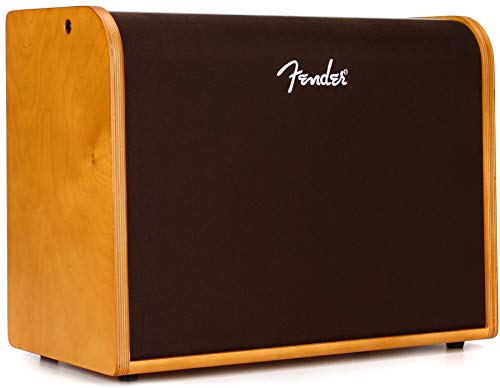
| Spec | Boss Acoustic Singer Live LT | Fender Acoustic 100 |
|---|---|---|
| Power output | 60 watts (bi-amp design) | 100 watts |
| Speaker | Custom-designed 6.5-inch woofer and dome tweeter | 8 inch full-range speaker with whizzer cone |
| Amp models or channels | Guitar and mic channels with independent three-band EQs; Acoustic Resonance (three types) on guitar channel | Two channels for instrument or microphone |
| Effects | Delay/chorus on guitar channel, delay/echo on mic channel, independent reverb on both channels, Enhance effect on mic channel, phase switch and notch filter | Studio-quality effects (specific types not detailed in listing) |
| Inputs and outputs | Guitar and mic inputs, aux input with level control, XLR DI jack, phones/recording output | Not published in listing |
| Headphone and line out | Phones/recording output | Not published in listing |
| Bluetooth and app | Not published in listing | Bluetooth wireless streaming; no app mentioned |
| Weight | Not published in listing | Not published in listing |
| Dimensions | Not published in listing | 14H x 18.5W x 9.25D inches |
| Included accessories | Not published in listing | Not published in listing; 2-year limited warranty stated |
Amp Models and Tone
The Boss Acoustic Singer Live LT uses a 60-watt bi-amp design with a 6.5-inch woofer and dome tweeter. Its guitar channel includes Acoustic Resonance with three types to correct piezo tone. Both guitar and mic channels have independent three-band EQ. This split design can improve clarity for acoustic guitar compared to a single full-range driver.
The Fender Acoustic 100 delivers 100 watts through an 8-inch full-range speaker with a whizzer cone. Its two channels handle instrument or microphone, but the listing does not describe EQ controls or tone shaping. Fender's higher wattage may offer more headroom, but published tone tools are less detailed than Boss. The whizzer cone may assist high-frequency dispersion.
The supplied scores for Tone and Amp Models are 26 for Boss and 24 for Fender. Boss names specific acoustic correction tools, while Fender relies on a straightforward two-channel platform. Buyers who need piezo correction and independent EQ will find more published detail on Boss. The published detail may reduce setup guesswork.
Effects and Features
Boss includes delay/chorus on the guitar channel and delay/echo on the mic channel. Both channels have independent reverb, and the mic channel adds an Enhance effect. A phase switch and notch filter help control low-frequency feedback. These specific effects suit users who want predictable acoustic treatment. No deep editing menus are required.
Fender lists studio-quality effects, but the listing does not name effect types or controls. This prevents a direct effect-by-effect comparison. Fender scores 15 and Boss scores 14 in Effects and Features, but Boss provides clearer published detail. The Fender's higher subscore does not offset the missing feature names.
Neither amp lists deep editing menus or an app. Boss does not mention Bluetooth or app support. Fender includes Bluetooth wireless streaming but no app. For effects, Boss offers confirmed nameable tools while Fender leaves details for buyer confirmation. Both amps avoid model menus and complex routing.
Power, Speaker and Volume
Boss uses 60 watts bi-amp with a custom 6.5-inch woofer and dome tweeter. This design may produce balanced projection for solo and small group performances. Fender uses 100 watts with an 8-inch full-range speaker and whizzer cone. The bi-amp arrangement sends low and high frequencies to dedicated drivers.
The higher wattage on Fender suggests more clean headroom for louder venues without PA support. Boss includes a tilt-back cabinet to improve high-frequency projection when placed on the floor. Neither listing states maximum SPL. A 100-watt amp may be more suitable for a medium coffeehouse without PA support.
For small gigs and rehearsals, both amps should provide adequate acoustic amplification. Fender may be better if sheer output is the priority, while Boss may offer more detailed separation through woofer and tweeter. Buyers should consider room size and PA use. A direct XLR output can extend the Boss into larger systems.
Build and Portability
Boss does not publish weight or dimensions, so portability is hard to assess. It includes a tilt-back cabinet, indicating a floor monitor style rather than a large open-back cabinet. Fender lists dimensions of 14H x 18.5W x 9.25D inches, which is compact. The omission of Boss size data is a clear disadvantage for planning transport.
Weight is also not published for Fender, so total carry load remains unknown for both. Fender listing states a 2-year limited warranty, but Boss does not state its warranty terms. Both amps score 8 out of 10 in Build and Portability. Neither product provides a way to verify carry weight from the listing alone.
Because Boss omits dimensions, Fender has an advantage for buyers who need to confirm fit in a car or storage. The Boss tilt-back design adds stage utility but does not replace missing size information. If weight matters, both listings leave that question unanswered. The Fender's published dimensions and warranty add a measure of buyer confidence.
Connectivity and Apps
Boss includes guitar and mic inputs, an aux input with level control, an XLR DI jack, and a phones/recording output. This gives a direct connection to a PA and a headphone or recording destination. Bluetooth and app support are not published for Boss. The XLR DI is particularly useful for live sound.
Fender includes Bluetooth wireless streaming for playback of backing tracks or songs from a phone. The Fender listing does not publish its input and output jacks, and it does not confirm a headphone, line out, or XLR DI. No app control is mentioned. This is the only wireless streaming feature published for either amp.
A direct comparison shows Boss offers more confirmed physical connectivity for performance and recording. Fender counters with wireless convenience for practice and break music. Neither amp lists USB audio, so computer recording would require another interface or adapter. Both amps lack USB audio connectivity according to the supplied listings.
Setup and Daily Use
Boss provides independent three-band EQ on both guitar and mic channels, so balancing two sources should be straightforward. Acoustic Resonance, a phase switch, and a notch filter give quick tools for common acoustic feedback and harshness. Daily use likely involves simple volume, tone, and reverb settings. The notch filter suppresses problem frequencies without detailed tuning.
Fender gives two channels for instrument or microphone, but the listing does not describe EQ controls, channel switching, or feedback filters. Bluetooth streaming is a convenient daily feature for playing along with music. Because the I/O is unpublished, confirming practice setup may require checking a manual. A published phone or line out would make practice more straightforward.
For a singer-songwriter who uses one guitar and one microphone, the Boss layout appears to cover all basic needs without hidden complexity. The Fender may be easier for casual Bluetooth playback, but missing effects and I/O make setup less transparent. Both avoid deep menus. This simplicity may appeal to players who dislike menus.
Home Practice Versus Stage
For home practice, Boss offers a phones/recording output for quiet practice or recording scratch tracks. Its 60-watt output may be more than enough for home use, and the tilt-back cabinet can direct sound toward the player. The XLR DI also allows direct connection to a PA. Headphone output can be a deciding factor for apartment dwellers.
Fender includes Bluetooth streaming for backing tracks at home, and its 100 watts provide ample clean volume for larger rooms. However, the Fender listing does not confirm a headphone output, which can limit late-night practice. Without a published XLR DI, sending a signal to a PA may be less direct. Some users may need a separate direct box without an onboard XLR.
On stage, Boss has a clear path to the PA through its XLR DI, while Fender may rely more on its onboard speaker volume. Fender's higher wattage could matter for small venues with no PA support. Both are described as suitable for small gigs, rehearsals, and home practice. The Boss's XLR DI allows a clean feed to the house system.
The Deciding Question
The main decision comes down to which published features matter more. Boss has confirmed direct connectivity and acoustic feedback control. Fender has higher wattage and Bluetooth streaming. If you value a clear XLR out, headphone/recording output, and specific EQ and feedback tools, Boss is more transparent. The Fender's Bluetooth streaming may matter more for casual practice.
If you prefer more onboard power and wireless backing tracks, Fender fits that need. Fender also publishes dimensions, which helps with space constraints. However, its missing I/O and effects details leave some uncertainty. The buyer must decide if that tradeoff fits their workflow.
The numeric scores are close, with Boss at 81 and Fender at 78, but they reflect different scoring categories. Boss earns more points in tone and connectivity, while Fender scores higher in effects and power. Buyers should weigh confirmed specs against potential extra power and wireless streaming. The final choice is not about which amp is objectively better but which feature set matches your needs.
Who Should Buy Which
Choose Boss if you are an acoustic guitarist or singer-songwriter who needs a compact dual-channel amp with independent EQ, Acoustic Resonance, phase and notch filters, and an XLR DI for small gigs and home practice. Its phones/recording output supports quiet practice. It is a focused tool for acoustic performance.
Choose Fender if you want a portable 100-watt amp with two channels and Bluetooth streaming, and you can verify the missing input and output details before buying. Its compact dimensions and higher wattage suit singer-songwriters who need more clean volume. The 2-year limited warranty adds some confidence, but the missing I/O remains a gap.
Avoid Boss if you need Bluetooth streaming, deep effects editing, USB audio, a battery-powered amp, or published weight and dimensions. Avoid Fender if you need detailed published specs for effects, I/O, headphone monitoring, or a direct XLR out. Each model is best for a different set of acoustic amplification priorities.
Boss Acoustic Singer Live LT
Pros
- Bi-amp design with dedicated woofer and tweeter
- Independent guitar and mic channels with three-band EQ
- Acoustic Resonance helps correct piezo pickup tone
- Phase switch and notch filter aid feedback control
- XLR DI and phones/recording outputs add flexibility
- Tilt-back cabinet improves projection
Cons
- Bluetooth and app support not listed
- No USB audio interface mentioned
- Weight and dimensions unpublished
- Only one delay/chorus type on guitar channel
- No battery power option in listing
Fender Acoustic 100
Pros
- 100 watts of acoustic power
- Two channels for instrument or microphone
- Bluetooth wireless streaming
- 8-inch full-range speaker with whizzer cone
- 2-year limited warranty
- Compact dimensions for portability
Cons
- Detailed effects are not specified
- Input and output jacks are not published
- Weight is not listed
- No app control mentioned
- No headphone or line out confirmed
Who Should Buy Each
Boss Acoustic Singer Live LT
- Singer-songwriters performing in small venues
- Acoustic players who want vocal and guitar channels in one amp
- Users who value simple analog-style controls over app menus
- Guitarists needing feedback suppression tools
Fender Acoustic 100
- Solo performers who need one amp for guitar and vocals
- Home players wanting Bluetooth backing tracks
- Fender fans seeking a lower mid-range acoustic amp with warranty
- Musicians playing small venues without PA support
Quick Decision Guide
| If you need a direct XLR DI for sending your signal to a PA | Choose Boss Acoustic Singer Live LT |
| If you want higher onboard wattage and Bluetooth playback | Choose Fender Acoustic 100 |
| If you need specific feedback controls like phase switch and notch filter | Choose Boss Acoustic Singer Live LT |
| If you need published compact dimensions and a 2-year warranty | Choose Fender Acoustic 100 |
| If you need a headphone or recording output for quiet practice | Choose Boss Acoustic Singer Live LT |
FAQ
About This Comparison
Daniel Brooks
Daniel Brooks edits the buying guides and how-to articles at Mandrillis. He works from manufacturer manuals, published specifications and common owner questions to explain music and audio gear in plain language, from turntables and headphones to digital pianos and electronic drums.
Read our full research methodology.
We may earn a commission at no extra cost to you.